
Spring Break for students and instructors means time off and often travel. For support staff I’ve come to realize that spring break is pretty much summed up in three things. Less noise, fewer places to get food on campus, and better parking. That’s it. I did however enjoy one extra perk. The library closed at 7:00pm instead of 2:00am and thus I was able to leave work Monday two hours earlier than the standard 9:00pm. My Monday schedule is in some ways cruel since Mr. Gaba’s latest work schedule involves working Tuesday to Sunday nights. That’s right. The only night he has off is the only night I work (barring my working the occasional Sunday 12:30 to 9:00pm shift.) So we took full advantage of my spring break and went out to eat Monday. Latif narrowed it down to three places: one in our Riverwest neighborhood, one Downtown, and one on the East Side. More than that he would not tell me. Mr. Gaba actively works to dissuade me of the notion that I should be able to plan and anticipate my future with any kind of a clear idea of what will happen. We were able to easily get a table at the place in Riverwest—the Centro Cafe. It’s a very small Italian place with amazing food, cooked just feet away from the tables in an open kitchen. I really hope we go again sometime.
As my spring break progressed I found myself spending several hours at the circulation desk. This was the result of the Access Services Librarian being out with health issues and no students volunteering to work during some parts of the break. I don’t blame the students. With the coffee shop closed the library has taken on the more hushed ambiance of those days when I was paid $3.75/hr to sit at the desk. It feels very familiar. Also familiar is the feeling that I had as a freshmen of not really knowing enough to be completely helpful. This is after all the first time I’ve been by myself at the circulation desk since last August. I’m OK with the basics, but if someone needed to pay a fine I would have had to call for backup. I also had to open the library myself on Thursday. It has been a few years since I opened a library and it wasn’t this library. I did manage to figure out where all the light switches were and how to log on to the circulation computers.
Saturday while students and faculty began considering having to head back to campus, I got to spend four hours at work. Only four. This is after all a break. The hours went by quickly as I had a test to proctor and then did two library instruction sessions for international MBA students who operate on a different academic schedule.
Spring break just isn’t what it used to be.
REG
lhg edited and approved
Thursday, March 24, 2011

Saturday, March 5, 2011
Liturgical Irony
I grew up a pastor’s kid in North Dakota. Our church didn’t bother with the “new” hymnal and stuck with TLH. The liturgy never changed. By the age of 10 I had stopped using the hymnal on Sundays for everything but the hymns. It was a great way to grow up. No matter what else was going on in my life that was a constant. Regrettably our little country church only had communion once a month and on high occasions like Christmas, Maundy Thursday, or Easter. Still, every time we had communion my father picked communion hymns, one before the consecration, one for the distribution and one after the benediction. A typical first Sunday of the month would have us singing “Draw Nigh and Take the Body of the Lord” before the sacrament. “Soul Adorn Thyself with Gladness” or “I Come O Savior to Thy Table” and we would end the service with “Oh Lord We Praise Thee.”
Our church restricted communion to those who had been confirmed, and that didn’t happen until after the eighth grade. Thus for most of my years at home, I sat in the pew and sang all of these hymns. “I Come O Savior to Thy Table” was an early favorite of mine. I remember singing the refrain: “May Thy body and Thy blood be for my soul the highest good” before I was in kindergarten. It was one of the few hymns that I could sing with the congregation before I could read. Later it was a big deal for me to get to sing that phrase all 15 times. This was not all that frequent of an occurrence. First there was the infrequency of communion and the fact that this hymn wasn’t sung every time. Add to that it was a distribution hymn so singing the entire hymn depended on enough people being in church to commune. Then the right organist had to be playing; one that didn’t feel the need to play an interlude every five verses to give our voices a break. You also lost the chance to sing them if you were communing, but this wasn’t too much of an issue for my family since we sat in the front (well, four or five pews back from the front, but no one sat in front of us) and was usually the first to commune and thus in the same table as the organist. The organ was just off the chancel. The most I would miss was the first stanza depending on how fast the organist got to the bench and how quickly she started playing. The last communion Sunday before I was confirmed everything came together and I got to sing all 15 versus.
Fast forward to now and I am glad to say that I have attended churches that offer communion every Sunday. But with this wonderful gain there has come some personally regrettable losses. First the liturgy keeps changing. This often happens with the church season and while I’ve become familiar with most of the orders in the hymnal, gone are the days where I can abandon the hymnal for everything but hymns. The second thing is now that communion is every Sunday I rarely sing communion hymns. Pastors use the distribution hymns to emphasis the theme of the Sunday and if several hymns are used he may toss in one communion hymn. The only service where I can count on singing them is Maundy Thursday. Couple this with a new hymnal and the regrettable practice of messing with the words and now when I do sing one of those old often repeated in my childhood hymns, I invariably end up frustrated by the changes. If I sang them more often I’d eventually get over this, or at least think about what the hymn is conveying instead of being angry at synodical busy bodies who felt the need to mess with something for some high minded reason like this word or that more accurately reflects the original form of the Latin or German or is a less archaic English word, completely disregarding the notion that some faithful Lutheran may have memorized this hymn in his childhood and isn’t going to appreciate the nuances. Alas, now that I get communion every Sunday I rarely sing about it and when I do, rather than it being a joy, for now, I just get annoyed.
REG
lhg edited and approved
Our church restricted communion to those who had been confirmed, and that didn’t happen until after the eighth grade. Thus for most of my years at home, I sat in the pew and sang all of these hymns. “I Come O Savior to Thy Table” was an early favorite of mine. I remember singing the refrain: “May Thy body and Thy blood be for my soul the highest good” before I was in kindergarten. It was one of the few hymns that I could sing with the congregation before I could read. Later it was a big deal for me to get to sing that phrase all 15 times. This was not all that frequent of an occurrence. First there was the infrequency of communion and the fact that this hymn wasn’t sung every time. Add to that it was a distribution hymn so singing the entire hymn depended on enough people being in church to commune. Then the right organist had to be playing; one that didn’t feel the need to play an interlude every five verses to give our voices a break. You also lost the chance to sing them if you were communing, but this wasn’t too much of an issue for my family since we sat in the front (well, four or five pews back from the front, but no one sat in front of us) and was usually the first to commune and thus in the same table as the organist. The organ was just off the chancel. The most I would miss was the first stanza depending on how fast the organist got to the bench and how quickly she started playing. The last communion Sunday before I was confirmed everything came together and I got to sing all 15 versus.
Fast forward to now and I am glad to say that I have attended churches that offer communion every Sunday. But with this wonderful gain there has come some personally regrettable losses. First the liturgy keeps changing. This often happens with the church season and while I’ve become familiar with most of the orders in the hymnal, gone are the days where I can abandon the hymnal for everything but hymns. The second thing is now that communion is every Sunday I rarely sing communion hymns. Pastors use the distribution hymns to emphasis the theme of the Sunday and if several hymns are used he may toss in one communion hymn. The only service where I can count on singing them is Maundy Thursday. Couple this with a new hymnal and the regrettable practice of messing with the words and now when I do sing one of those old often repeated in my childhood hymns, I invariably end up frustrated by the changes. If I sang them more often I’d eventually get over this, or at least think about what the hymn is conveying instead of being angry at synodical busy bodies who felt the need to mess with something for some high minded reason like this word or that more accurately reflects the original form of the Latin or German or is a less archaic English word, completely disregarding the notion that some faithful Lutheran may have memorized this hymn in his childhood and isn’t going to appreciate the nuances. Alas, now that I get communion every Sunday I rarely sing about it and when I do, rather than it being a joy, for now, I just get annoyed.
REG
lhg edited and approved
Saturday, February 26, 2011
My Life as a Public Worker in Wisconsin
For 18 months of my life I was a public worker in Wisconsin. I was a Circulation Assistant 1 at Milwaukee Public Library’s Central Library. If I had kept that job my life would be much different. I’d be earning, even without my library degree, much more than I am now and I’d be fully vested in a very nice pension plan. If I had gotten my degree while working there, the city would have paid for it, and I wouldn’t still be shelling out monthly to pay for student loans. The Christmas I worked there was wonderful—we were able to afford to give Usinger sausage gift boxes to our parents and siblings. Something I’ve never been in a position to do since. Loved the union wage. Loved the benefits. Loved the library. Hated the union.
I hated that money out of each of my paychecks, only about, I think, $16, went to the union. Now when you are earning so much more than a non-union library job with all the perks and benefits, four hundred some odd dollars a year is a small price to pay. I understood that I benefited from their collective bargaining and I was OK with that money being taken, but I didn’t like that my money was going to support political causes to which I was fundamentally morally opposed. In particular, supporting organizations and candidates who believe that women have a right to murder their own children, provided it’s done in the womb. When asked by co-workers why I didn’t join the union I stated flatly, “I don’t fiscally support the candidates I do vote for, why would I support the ones I disagree with?” But I had no choice in the money being taken.
The only recourse I had as a non-union member was to apply to get back the portion of my union dues that went to political contributions. It was claimed that it amounted to only something like $24 a year, but it’s the principle of things, so I went through the hassle of hunting down the form and having each person I needed to speak to along the way look at me like some sort of diseased moron for wanting to do such a thing. The form was cumbersome and tedious and on the form in no less than seven places was written that the union was not responsible for the form getting lost in the mail. The form then had to be mailed. No person or address was given. I could not deliver it in person. I could not send it registered mail. It had to go to a designated PO Box. If this box did not exist, or if a postal worker just kept “losing” things addressed to it, I never discovered. I moved to Fort Wayne and was not sticking around to fight. I never got my money back.
Just after I started at the library, the union contract expired and the negotiations were not going smoothly. In the end the whole thing went to arbitration. It took almost the entire time I worked there, before it was settled. Every worker got an extra $100 just for the union finally agreeing to the contract and then got a very nice check of back wages to settle the wage increase from the year before that we would have gotten all along if negotiations hadn’t taken so long. It was crazy.
Now I believe in public libraries. I think they contribute greatly to an educated free society and do more than any other institution to bridge the digital divide. I’m proud of my city for having one of the oldest public library systems in the country. I think library workers should make a livable wage and that they do our city and the public a great service. But even with a large cut in pay I was very glad to get back to private academia, because it irked me that money I worked for helped pay for the union president to attend Bill Clinton’s inaugural ball in Washington DC. It irked me that the union president was a co-worker who would decide on a whim to enforce or not bother with library rules and policy and was never reprimanded or corrected for such behavior. It also irked me that nobody in that place was willing to lift a finger outside of their assigned time and duties to make the library a better place to work.
I personally spent months of lunch hours relabeling one of the underground tiers of journals so I could find things faster. Everyone who went to that floor benefited from my work, but when I mentioned that I was doing this during my lunches I was generally scorned. The idea that workers would use their own initiative or worse yet, time, to improve their workplace was a foreign concept to my union minded co-workers. So was the idea of doing tasks as a team and completing them efficiently. One time I was assigned to spend two hours on a shifting project that involved moving two columns (14 shelves) of government documents from one range of shelves to a range that was about ten feet away. My supervisor looked at me like I was crazy when I requested working with a co-worker and using a cart, but finally agreed. We got them all shifted within an hour. My supervisor was amazed because she figured that task would take at least another week to complete. Of course if I had been taking them by handfuls instead of loading them on a cart with each person using one hand to hand the thing off, and one hand to keep the documents from flopping over while filling a cart shelf—yes it would have taken another week to finish the job.
Just before I started, the Milwaukee County Federated Library System started to use a new library automation system. It was the same system I had used at two other libraries: Libraries where I did the same sort of work for less than half the hourly rate and with lesser or no benefits. To many of my co-workers learning a new system was a hardship. Their response was not to use their collective bargaining to get us better or more training. Or even a seminar on dealing with stress in the workplace, but rather to argue for higher wages since their jobs were so much more stressful what with having to learn the new computer system. I’m glad to say the city rejected the appeal, but it made me wonder about how much of those mandated collective bargaining dues went towards this frivolous and downright silly play for more money, not to mention how much of my tax dollars the city had to spend responding to it.
All this is to say that my eighteen months over a decade ago as a city worker represented by a public employees union has colored the way I view the current budget battle in Wisconsin. I support Governor Scott Walker.
REG
lhg edited and approved
I hated that money out of each of my paychecks, only about, I think, $16, went to the union. Now when you are earning so much more than a non-union library job with all the perks and benefits, four hundred some odd dollars a year is a small price to pay. I understood that I benefited from their collective bargaining and I was OK with that money being taken, but I didn’t like that my money was going to support political causes to which I was fundamentally morally opposed. In particular, supporting organizations and candidates who believe that women have a right to murder their own children, provided it’s done in the womb. When asked by co-workers why I didn’t join the union I stated flatly, “I don’t fiscally support the candidates I do vote for, why would I support the ones I disagree with?” But I had no choice in the money being taken.
The only recourse I had as a non-union member was to apply to get back the portion of my union dues that went to political contributions. It was claimed that it amounted to only something like $24 a year, but it’s the principle of things, so I went through the hassle of hunting down the form and having each person I needed to speak to along the way look at me like some sort of diseased moron for wanting to do such a thing. The form was cumbersome and tedious and on the form in no less than seven places was written that the union was not responsible for the form getting lost in the mail. The form then had to be mailed. No person or address was given. I could not deliver it in person. I could not send it registered mail. It had to go to a designated PO Box. If this box did not exist, or if a postal worker just kept “losing” things addressed to it, I never discovered. I moved to Fort Wayne and was not sticking around to fight. I never got my money back.
Just after I started at the library, the union contract expired and the negotiations were not going smoothly. In the end the whole thing went to arbitration. It took almost the entire time I worked there, before it was settled. Every worker got an extra $100 just for the union finally agreeing to the contract and then got a very nice check of back wages to settle the wage increase from the year before that we would have gotten all along if negotiations hadn’t taken so long. It was crazy.
Now I believe in public libraries. I think they contribute greatly to an educated free society and do more than any other institution to bridge the digital divide. I’m proud of my city for having one of the oldest public library systems in the country. I think library workers should make a livable wage and that they do our city and the public a great service. But even with a large cut in pay I was very glad to get back to private academia, because it irked me that money I worked for helped pay for the union president to attend Bill Clinton’s inaugural ball in Washington DC. It irked me that the union president was a co-worker who would decide on a whim to enforce or not bother with library rules and policy and was never reprimanded or corrected for such behavior. It also irked me that nobody in that place was willing to lift a finger outside of their assigned time and duties to make the library a better place to work.
I personally spent months of lunch hours relabeling one of the underground tiers of journals so I could find things faster. Everyone who went to that floor benefited from my work, but when I mentioned that I was doing this during my lunches I was generally scorned. The idea that workers would use their own initiative or worse yet, time, to improve their workplace was a foreign concept to my union minded co-workers. So was the idea of doing tasks as a team and completing them efficiently. One time I was assigned to spend two hours on a shifting project that involved moving two columns (14 shelves) of government documents from one range of shelves to a range that was about ten feet away. My supervisor looked at me like I was crazy when I requested working with a co-worker and using a cart, but finally agreed. We got them all shifted within an hour. My supervisor was amazed because she figured that task would take at least another week to complete. Of course if I had been taking them by handfuls instead of loading them on a cart with each person using one hand to hand the thing off, and one hand to keep the documents from flopping over while filling a cart shelf—yes it would have taken another week to finish the job.
Just before I started, the Milwaukee County Federated Library System started to use a new library automation system. It was the same system I had used at two other libraries: Libraries where I did the same sort of work for less than half the hourly rate and with lesser or no benefits. To many of my co-workers learning a new system was a hardship. Their response was not to use their collective bargaining to get us better or more training. Or even a seminar on dealing with stress in the workplace, but rather to argue for higher wages since their jobs were so much more stressful what with having to learn the new computer system. I’m glad to say the city rejected the appeal, but it made me wonder about how much of those mandated collective bargaining dues went towards this frivolous and downright silly play for more money, not to mention how much of my tax dollars the city had to spend responding to it.
All this is to say that my eighteen months over a decade ago as a city worker represented by a public employees union has colored the way I view the current budget battle in Wisconsin. I support Governor Scott Walker.
REG
lhg edited and approved
Sunday, October 31, 2010
Opinions on trick-or-treaters
I spent about three hours today dressed for warmth and hanging out on my porch to give out candy. Mr. Gaba joined me for about an hour and a half of it, and for almost the entire three hours a neighborhood boy, Tony, sat on our porch swing and we chatted. Other neighbors stopped by and mostly it was a pleasant way to spend a few hours. Last year I ran out of candy in less than one hour so this year I over-bought, but it became clear that this October I’m on a much less popular street.
I bear no ill will to the late October beggars who come clambering up my stairs for candy, but I do expect them to at least attempt to costume themselves with more than a grocery bag in hand to identify themselves as trick-or-treaters. In one case, two boys clad in jeans, sneakers, dark sweatshirts and open jackets (it was hovering just below 50 degrees) climbed up my stairs and held out their Wal-mart bags, I asked, “So what are you supposed to be?” They stared at me, ignored my question, said, “Trick or Treat” and then failed to say thank you after I put candy in their bags. At that point I decided that any kid approaching with no sign of any costume would get one piece of candy. Kids who made an effort of any sort: face paint (one kid had his face painted black which was hard to see until he got up my stairs since it was almost the same shade as the rest of his skin), a hat or even a mask carried in their hand or worn off their face would get two. The fully clad Spiderman got four.
The other thing I noticed was the lack of imaginative costumes. They either didn’t try to dress up at all, only wore one piece of costume, or were in obviously store bought costumes that screamed “we went to a Halloween store.” There were no monochromatic kids with cone shaped paper hats and a hand drawn color label down their front and back, no cardboard robots, no fairies with tinfoil star wands, not even an assortment of bums or hobos. The closest to made-it-up-from-what-we-had-around were two boys with shoulder pads who carried helmets that appeared to be part of their pee-wee football uniforms. It is sort of sad. When I was a kid Halloween was an occasion for creativity and ingenuity; now it’s just an opportunity to get candy—costume optional. In some cases coming to the door was optional as well, as in the case of one mother holding three bags and expecting me to put treats in each, as her little ones didn’t want to get out of the warmth of the car—they also only got one piece each.
REG
lhg edited and approved
I bear no ill will to the late October beggars who come clambering up my stairs for candy, but I do expect them to at least attempt to costume themselves with more than a grocery bag in hand to identify themselves as trick-or-treaters. In one case, two boys clad in jeans, sneakers, dark sweatshirts and open jackets (it was hovering just below 50 degrees) climbed up my stairs and held out their Wal-mart bags, I asked, “So what are you supposed to be?” They stared at me, ignored my question, said, “Trick or Treat” and then failed to say thank you after I put candy in their bags. At that point I decided that any kid approaching with no sign of any costume would get one piece of candy. Kids who made an effort of any sort: face paint (one kid had his face painted black which was hard to see until he got up my stairs since it was almost the same shade as the rest of his skin), a hat or even a mask carried in their hand or worn off their face would get two. The fully clad Spiderman got four.
The other thing I noticed was the lack of imaginative costumes. They either didn’t try to dress up at all, only wore one piece of costume, or were in obviously store bought costumes that screamed “we went to a Halloween store.” There were no monochromatic kids with cone shaped paper hats and a hand drawn color label down their front and back, no cardboard robots, no fairies with tinfoil star wands, not even an assortment of bums or hobos. The closest to made-it-up-from-what-we-had-around were two boys with shoulder pads who carried helmets that appeared to be part of their pee-wee football uniforms. It is sort of sad. When I was a kid Halloween was an occasion for creativity and ingenuity; now it’s just an opportunity to get candy—costume optional. In some cases coming to the door was optional as well, as in the case of one mother holding three bags and expecting me to put treats in each, as her little ones didn’t want to get out of the warmth of the car—they also only got one piece each.
REG
lhg edited and approved
Thursday, October 14, 2010
Dorian's tale last report from the air.

Sep 12, 2010 in the air over America
When asked what I wanted to do in Utah I came up blank. While I feel that it is always good when you travel to try and take in the local culture I made the trip to get a cat and I was more than a little short on ideas. One thing was for sure. I don’t really care at all about Mormon history. In the end we did something that I’m very glad indeed that I did. Sadly without a guided tour, but I visited the state capital. It makes for a rather odd addition to capitals I’ve scoped out: North Dakota, South Dakota, Montana, Minnesota, Wisconsin, Indiana, Illinois, and Utah. (Insert Sesame Street—“One of these things is not like the others” music here)


After the capital we stopped a few streets away at the Catholic cathedral which, of all the catholic buildings I’ve been in is, in decorating terms, “Not afraid of color.”


So I managed to find a state building and a church to tour in Utah, and I took pictures of the lions and a Manhattan Indian and avoided shots of Brigham Young.
We also stopped at an Old Navy to get Jillian some much needed fall clothes, and in the process drove past a Brazilian festival at the downtown mall.
While Utah is not known for its great food I did enjoy some all you can eat sushi, some really good hummus and pita bread at a place called Roosters, and when we went to a Five Guys burger joint I learned of a local custom—fry sauce. Fry sauce is an alternative to ketchup for your fries. It consists of ketchup, mayo and pickle juice. I tried it twice to be sure, but I don’t think I’ll be trying to make my own at home.
In my mixed up, screwed up head I planned this trip with the impression that I was coming home on Monday, so I packed for that and it wasn’t until we were headed to the capital on Saturday that I learned of my mistake. We double checked our various itinerary e-mails when we got back before dinner and sure enough I was flying out Sunday. I then once again got in frantic traveling mode. It’s just as well that I spent most of Saturday believing I had an extra day, it made me a much calmer person to be around.


I had told Latif he was getting me Monday so I called and left him a message to return my call so I would sleep better. He called somewhere close to 11pm and I slept as well as I can the day before flying. I was up at 5am. I used the computer and read up on flying with cats and what to expect. I made a list of things of Dorian’s that I needed to ask about and then I got myself ready and packed everything up. 8:20 we left for church. It was about 12:30 when we got home. I changed and gathered things up and said goodbye and they said goodbye to their cat. For all concerned this is the best of all worlds. They know Dorian is going to a good home they know that they will be able to see him come summer when they visit Milwaukee again for the SSP retreat and to take in that great city on a Great Lake.
Five years ago the Greens took Dorian in. Five years ago I lost both my cats. I was offered many cats after I lost the second one in our house fire, but I think we were just waiting for Dorian to need a home. In about two hours he’ll be in Riverwest.


Sunday, October 10, 2010
Dorian's back story

Mike and Amy had friends in New Orleans who bought a home and were told that the cat came with it. The friends were told the cat male but as it turns out that “male” cat gave birth to kittens underneath the home. They were all terribly flea infested, one was so bad her back legs had so much blood drawn that she couldn’t stand. That kitten was taken to the vet, cleaned up and named Gloria. Mike and Amy took her home and spoiled her rotten. Gender confusion seemed to run in the family, because after a while someone pointed out that Gloria was a male. Not wanting to confuse a cat that had gotten used to the tone of his name they searched for something male that sounded similar enough and settled on Dorian. That is how an orange and white cat ended up with a name that leads everyone to assume that he is gray. Dorian by then was completely healthy—he has a slightly unusual gate for a cat but you’d have to be looking for it to notice. He was also neutered and much to his owner’s later regret completely declawed. He will have to remain an indoor cat for the rest of his life. Just as he was getting to full size Katrina hit. The Greens were on the move and Dorian became a Katrina refugee. Mike got a job in Salt Lake and they relocated there. Amy flew with Dorian to their new home on Delta and bought the carrier that he now sits in at my feet.
Dorian enjoyed only-child status in the home, as the Greens worked to adopt, being told that they just may not be able to have children in the more conventional way. Dorian got used to not having children around and when a small nephew visited, decided that he didn’t like this little person and bit him. Not long after that, God surprised the Greens with Jillian, their miracle baby. Now Amy had a problem. Dorian was not getting the attention he was used to and went into a deep depression, she considered giving him to a no-kill shelter, but felt that she would always worry that a new owner would abuse him or let him outside. She wasn’t sure that Dorian would take to Jillian once she became mobile, and keeping up with the amount of fur was getting hard since the baby took priority. “I’d be coming upstairs with a baby in one arm and laundry in the other and see him and realize that I hadn’t pet him all day. I just felt so guilty.”
The timing of this small new addition to our lives truthfully could not be better. Latif is working essentially 2nd shift. The change from three months of him being there to him being almost instantly totally absent was startling, so I’m glad that in the evenings I will have someone to keep me company and to talk to. Cats are great listeners, as I discovered with my cat Neko when I was a teen. If you talk to yourself people will think you are crazy but talking to an animal is perfectly sane, though I will admit that I got some stares for appearing to talk to my carry-on luggage.

Monday, October 4, 2010
Dorians Tale part 3
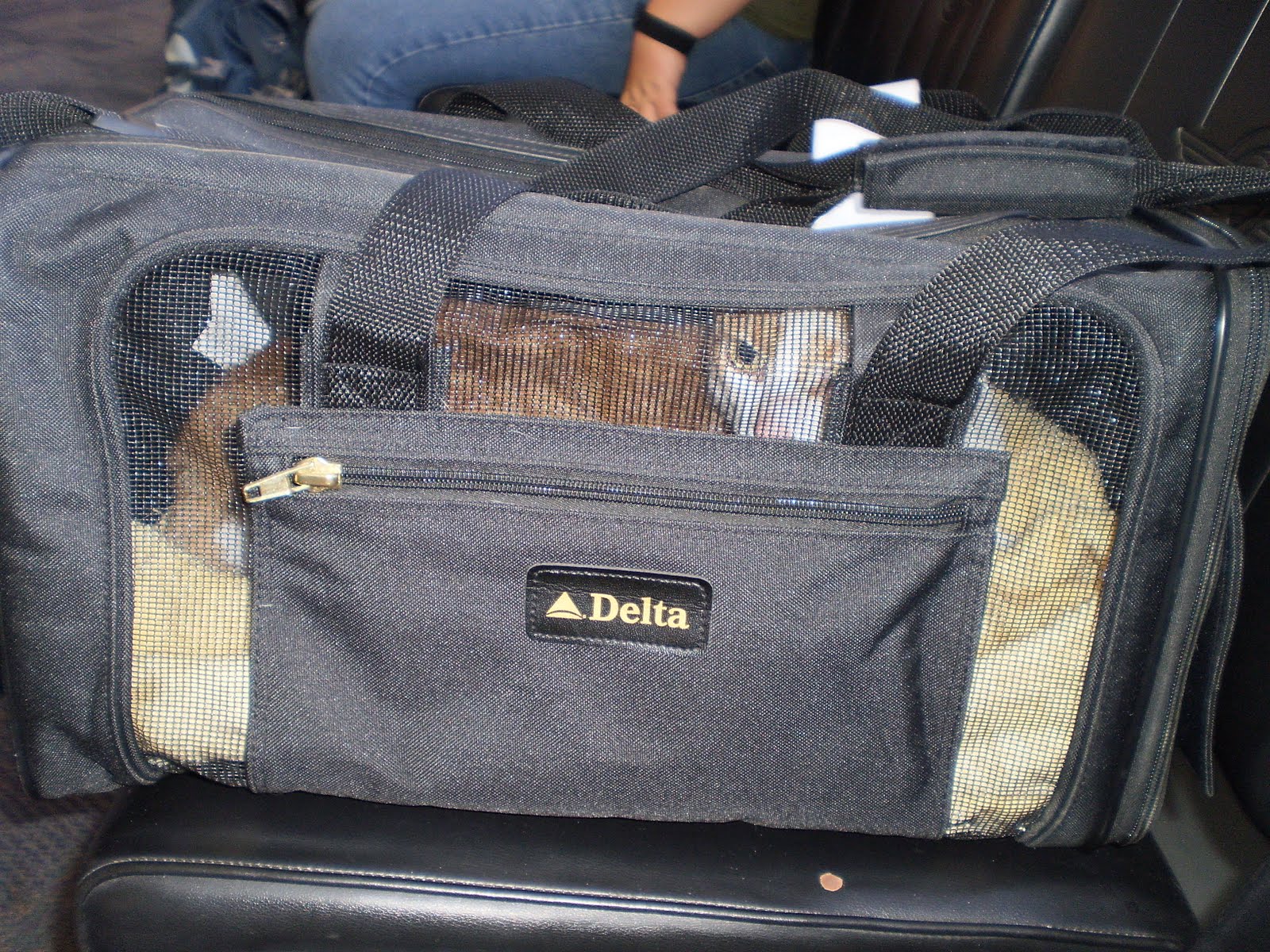
Sep 12, 2010 6:40pm Las Vegas
Dorian is stowed below the seat in front of me for what, I’m sure he hopes, is his last flight. Again it’s a full flight and again it is leaving late.
I got to the Salt Lake airport with plenty of time. Paid the $75 for pet transport, got him tagged, and then turned my bags over to security. I checked two bags. One was my stuff; the other was a hard case pet taxi, filled with Dorian’s food, toys, water bowl, and litter scoop & lint rollers. With wheels on the suitcase and cat stuff not weighing as much as the cat, I found getting to security a bit of a challenge. I ended up making a request at security; Dorian was skittish and I didn’t want to take him out of the bag. I asked if it could be hand inspected they said no but opened a gate and took the cat carrier. I went through security and followed two security agents to a small room where I held Dorian and an agent patted him down (she really likes cats.) while the other one ran the carrier through the x-ray machine. They declared both bomb free. When the guy brought in the bag Dorian practically jumped back into it and squatted down to make it easy to zip shut. It was a far cry from the wrestling match Amy and I did to get him zipped into it for the trip to the airport.
After security I needed to hike to my gate. It was not a short trip and while Dorian is not the fattest cat I’ve ever owned, he’s not the lightest either. The carrier has no wheels and by the time I found my gate the first order of business was getting a drink, and taking some pills for my back and then doing a little bit of stretching—stretching that I failed to do in Vegas. I didn’t notice until that point that the flight was delayed. We got off the ground an hour late. I felt sorry for Dorian who could have enjoyed another hour not trapped in a carrier. That’s the thing, as long of a day as it is for me I can at least do things like eat, drink, and most importantly, use a bathroom. I did bring a bit of food for him but we cut off his water supply before leaving for church. I’ve wet my fingers a few times on my trips to bathrooms and stuck them in the carrier in case he would like to lick them dry. I’ve also grabbed a few of his food pellets and from time to time have offered him some. In truth I’m glad that my flight from Salt Lake was late because given the choice I’d much rather sit in that airport and watch the Packer game on monitors, than sit in the sun in Vegas and have to look at slot machines. Go Pack Go. The game was just finishing the 3rd quarter when we boarded. For the first half I was sitting too far away. I thought Dorian would enjoy looking out a window so I sat by the windows that were far from the monitors. People asked about him and I happily told his story. Vegas no one made eye-contact even though we’re all headed back to Wisconsin. I tried to strike up a conversation with one woman, but she didn’t seem to enjoy the idea of returning to Milwaukee as much as I did.
In Las Vegas we were supposed to land at gate B12 and the flight was to take off from B12, but because they were holding flights for those who were late our plan gated at B20 and again I had some walking to do with a very squirmy cat. With Southwest’s numbered boarding system and this trip being planned back in July, I had good numbers. For the first flight I was the 68th passenger to board. For the next I was 32. All the planes are the same 737s and If you must know I like to sit just behind the wing on the left side when facing front. Row 17 is my favorite but with a bunch of crumbs on the floor this flight I moved one row back and I’ve got to tell you I don’t like the position of the windows. It’s kind of sad. Each flight is a bit less fun than the one before. The pilot just chimed in and the wind is in our favor so we may not be too late. The book I was reading I finished, so all I’ve got now is my writing.
I didn’t’ buy dinner; the Vegas airport did not impress me at all.
Subscribe to:
Posts (Atom)